
SIP Load Balancer
SIP-LB is the SIP-layer counterpart to Slicce's signalling load balancer family — SS7-LB for SIGTRAN/SCCP, DMT-LB for Diameter, GTP-LB for GTP-C. It sits between SIP originators and a pool of SIP destinations — softswitches, IMS core elements, or application servers — distributing and routing session signalling across them from a single multi-client/server node, administered over a REST API rather than through per-peer configuration on every downstream element.

Features & Benefits
Multi-client/server SIP routing from one node
Following the pattern set by SS7-LB and DMT-LB, SIP-LB terminates SIP signalling from multiple originators and routes each dialog to the right destination from a single instance, rather than requiring point-to-point trunking between every client and every server.
Routing by realm-equivalent identifiers
Where DMT-LB routes Diameter traffic by realm and GTP-LB by IMSI/APN, SIP-LB routes calls by Request-URI, domain, or a configurable dial-plan table — one routing layer instead of per-destination configuration on each originator.
REST administration, not box-by-box configuration
Peers, routing rules and service state are managed through the same kind of REST admin API already exposed by SS7-LB and DMT-LB, so SIP routing changes are an API call rather than a maintenance window on a softswitch.
Consistent operability across the signalling estate
CDR, audit and alarm logging, and SNMP traps for link and peer state, follow the same format already used across the Slicce load balancer family, so SIP traffic is observable through the same tooling as SS7, Diameter and GTP.
Route SIP signalling across multiple destinations from one node
The SIP counterpart to SS7-LB, DMT-LB and GTP-LB, entirely inside the operator domain
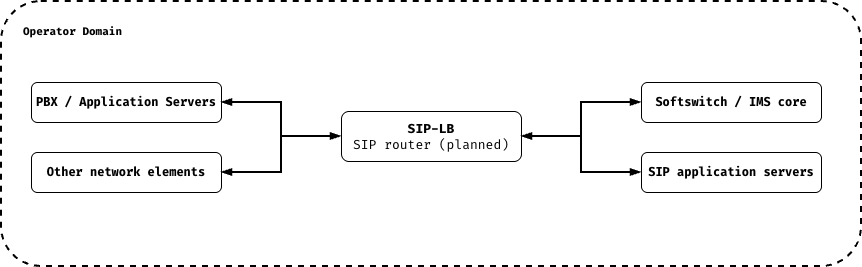
Deployed between SIP originators (PBXs, application servers, other network elements) and a set of SIP destinations, SIP-LB terminates signalling from each originator and routes each dialog to the appropriate destination based on its routing table, administered over REST rather than through per-peer configuration.
Technical specifications
REST Admin API
Slicce internal (pattern shared with SS7-LB / DMT-LB / GTP-LB)
SIP
Softswitch / IMS core / SIP application servers
IETF RFC 3261
SIP over TCP / TLS
IETF RFC 3261, RFC 8446
SIP over UDP
IETF RFC 3261
Architecture
Pattern inferred from the SS7-LB, DMT-LB and GTP-LB siblings — no dedicated SIP-LB architecture document
Ask us for the swagger file...
Contact us