
MLC API Exposure Function
MLC-AEF is a location engine that exposes mobile subscriber positioning as a set of northbound APIs. 3GPP TS 23.271 defines the Location Services (LCS) architecture that lets a Gateway Mobile Location Centre resolve a subscriber's whereabouts without the requesting application ever touching SS7 signalling. MLC-AEF implements that gateway function — MAP, TCAP, SCCP and M3UA over SCTP toward the mobile network — so device positioning, cell identity and serving-node lookup become REST calls rather than Diameter or MAP operations, with connectivity to more than one mobile network from a single instance via its SCCP routing table.

Features & Benefits
Three positioning APIs, one gateway
Provide Subscriber Location, Anytime Interrogation and Send Routing Info For Location are exposed from a single node. An application resolves exact coordinates through the network's SMLC when one exists, falls back to last-known Cell ID when it doesn't, or simply resolves the serving node address and IMSI behind an MSISDN — without three separate integrations.
Multi-network SCCP routing from one instance
A configurable SCCP routing table — global titles, point codes, subsystem numbers, and solitary, dominant or load-sharing rules — lets one MLC-AEF instance reach several mobile networks at once and route each location query to the right one.
Overload and link state visible where operations already look
Service state, SCTP link state, M3UA peer state and overload threshold breaches are reported as SNMP traps, alongside a CDR stream per location transaction (dialog, invoke ID, MSISDN, IMSI, duration, response outcome). Positioning traffic is observable through the same tooling as the rest of the signalling estate.
Designed for exposure through the operator's API framework
MLC-AEF's configuration includes a CAPIF binding — a Core Function URL and a cyclic publishing interval — so the same three location APIs can be onboarded, authorized and routed through the Common API Framework when the operator chooses to expose them beyond its own network.
Resolve subscriber location without touching MAP or SS7
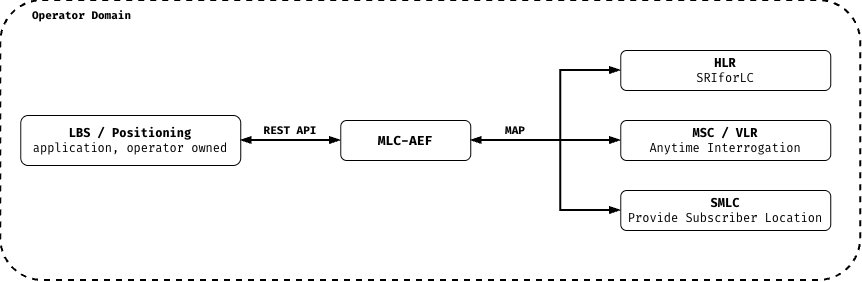
Positioning and serving-node lookup, entirely inside the operator domain
Deployed between a location based service platform and the mobile network, MLC-AEF resolves subscriber position, cell identity or serving node address on request, translating each REST call into the corresponding MAP operation toward the HLR, MSC/VLR or SMLC and returning the result over HTTP/2.
This mode suits an operator running its own LBS platform, emergency positioning service, or internal network diagnostics tooling.
Expose positioning APIs to a 3rd party domain with the CAPIF CF
MLC-AEF CAPIF mode, positioning APIs with 3rd Party Exposure
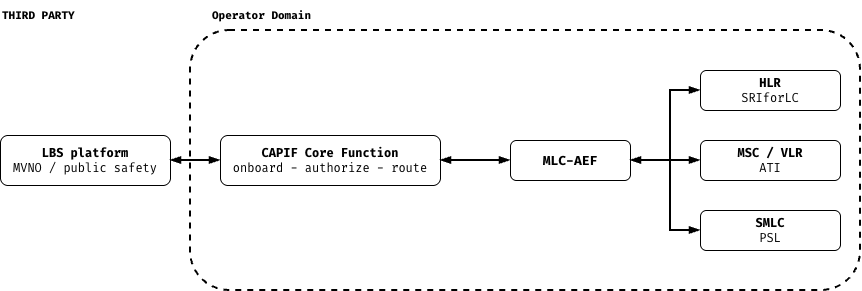
Where an operator exposes positioning capability to enterprises, MVNOs or public-safety and LBS platform providers, MLC-AEF publishes its service APIs to the CAPIF Core Function on the configured interval. The CAPIF Core Function onboards the API invoker, applies the negotiated security method and routes authorized requests to the exposure function. The consumer integrates against a standard northbound API, while the operator retains a single point of authorization, logging and charging — the same framework already used across the Slicce API exposure function family.
Technical specifications
Provide Subscriber Location
3GPP TS 23.271 (LCS stage 2)
TS 29.002 (MAP-PROVIDE-SUBSCRIBER-LOCATION)
Anytime Interrogation
3GPP TS 29.002 (MAP-ANY-TIME-INTERROGATION)
Send Routing Info For Location
3GPP TS 29.002 (MAP-SEND-ROUTING-INFO-FOR-LCS)
CAPIF
3GPP TS 29.222
Transport
HTTP/2, JSON
MAP
HLR, MSC/VLR, SGSN, SMLC
3GPP TS 29.002
TCAP
ITU-T Q.771–Q.775 / ANSI T1.114
SCCP
ITU-T Q.711–Q.714 / ANSI T1.112
M3UA
IETF RFC 4666
SCTP
IETF RFC 4960
Architecture
3GPP TS 23.271 — Functional stage 2 description of Location Services (LCS)
Ask us for the swagger file...
Contact us