
GTP Load Balancer
GTP-LB is a GTP-C signalling proxy that sits between session-originating elements and a set of GGSN/PGW-side destinations, forwarding tunnel-management signalling — Create PDP Context on GTPv1, Create Session on GTPv2 — and every subsequent message in that tunnel's lifetime to the peer resolved for the subscriber, while rewriting the control-plane address so return traffic keeps flowing through it.
Features & Benefits
GTPv1-C and GTPv2-C from one node
GTP-LB decodes and proxies both GTP protocol generations' control- plane signalling — Echo, Create PDP Context (v1) and Create Session (v2) — so a network running either generation, or both during a migration, is served by a single instance.
Subscriber-aware peer selection
Incoming session-establishment requests are matched against a rules table by IMSI or APN prefix, directing each subscriber's session to its configured destination rather than a single static peer for all traffic.
Session-aware forwarding for the life of the tunnel
Once a session is established, GTP-LB caches the TEID pairing and uses it to forward every subsequent message for that tunnel — Update, Delete and other in-session signalling — to the correct peer without re-evaluating the routing rules each time.
Transparent to both ends
GTP-LB rewrites the GSN address (v1) or F-TEID (v2) in signalling responses to point back at itself, so neither the originator nor the destination needs to be aware that traffic is being proxied.
Proxy GTP-C signalling to the right destination by subscriber
Session-aware forwarding for the life of the tunnel, entirely inside the operator domain
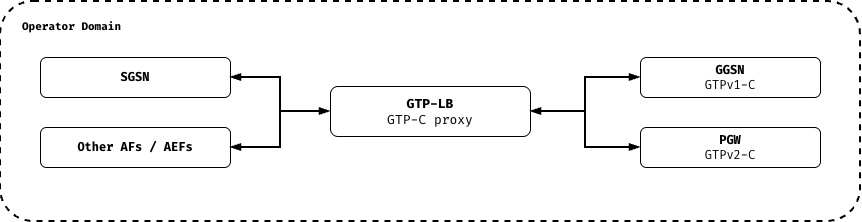
Deployed between GTP-C originators (SGSNs, other AFs/AEFs) and a set of GGSN/PGW destinations, GTP-LB inspects each session-establishment request, resolves the destination by IMSI or APN, and proxies the resulting tunnel's signalling for its lifetime.
Technical specifications
GTPv1-C
SGSN, GGSN
3GPP TS 29.060
GTPv2-C
SGW, PGW, MME
3GPP TS 29.274
Transport
UDP (port 2123)
Architecture
GTP-C signalling relay across GTPv1 (TS 29.060) and GTPv2 (TS 29.274) — no single dedicated architecture document
Ask us for the swagger file...
Contact us